
What is learning in the age of generative AI? From panic to evidence

I will be presenting this research at the upcoming XVII International Workshop ACEDEDOT – OMTECH 2026, taking place in Almería, Spain, from March 12-14, 2026:

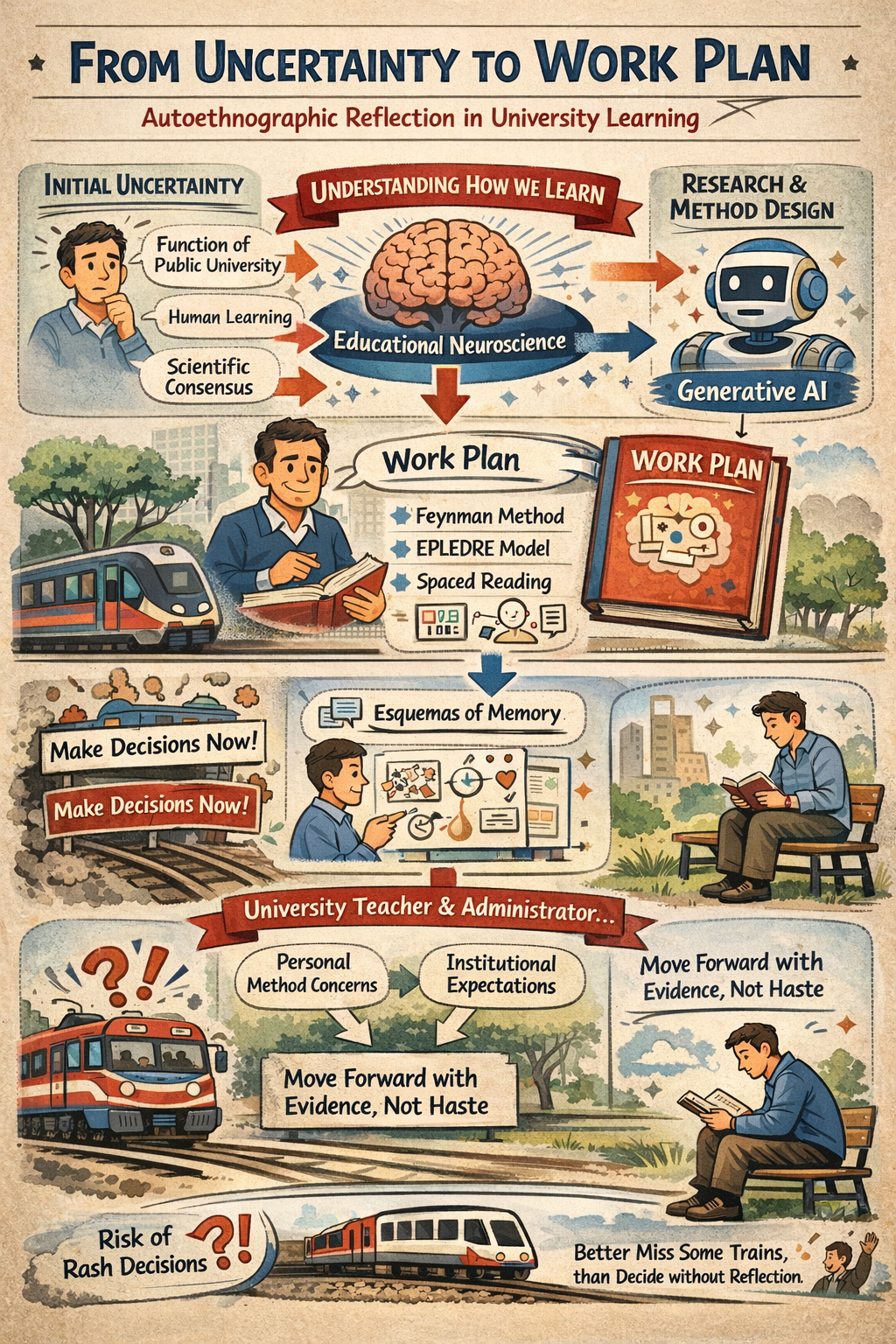
This communication presents an autoethnographic reflection. Building on four fundamental premises about the function of Spanish public universities and the established mechanisms of human learning, the author documents his personal journey from initial uncertainty to the design of a systematic work plan. The study focuses on understanding the current scientific consensus on how learning is consolidated in the brain and exploring the possibilities of generative AI to enhance this process in the university context. Drawing on the work of Héctor Ruiz Martín, a work plan is designed that combines recommendations from educational neuroscience with the Feynman method and the EPLEDRE model, including spaced reading, creation of sketchnote-type graphic schemes from memory, and public communication of the knowledge constructed. The communication shares the first graphic schemes developed and reflects on the author’s dual position as university teacher and administrator, facing both his own methodological uncertainties and institutional expectations for strategic guidance. It questions the “collective panic” surrounding the emergence of generative AI in universities and the pressure to make quick decisions without sufficient reflection. It proposes replacing reactive urgency with a deliberate process of calm, evidence-based reflection and pilot experimentation, recognizing that in contexts of accelerated change, it is preferable to miss some “trains” rather than make biased decisions under collective amygdala hijacking

Keywords: Learning; autoethnography; generative artificial intelligence; university learning; educational neuroscience; teaching transformation
Learning; autoethnography; generative artificial intelligence; university learning; educational neuroscience; teaching transformation

Visitas: 28

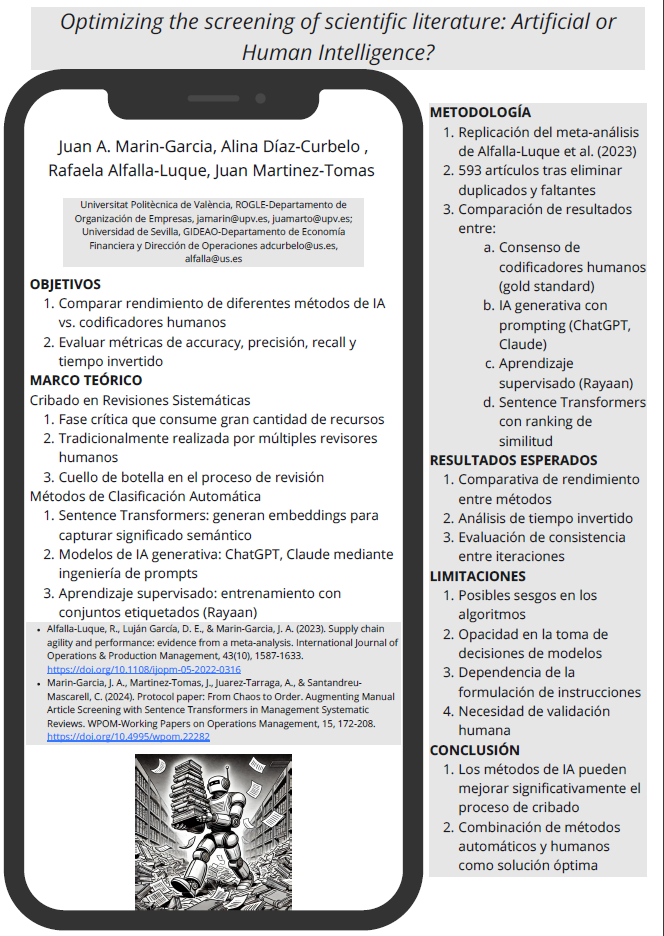
Optimizing the screening of scientific literature: Artificial or Human Intelligence?

El 14 de marzo 2025, presentaremos nuestro trabajo Optimizing the screening of scientific literature: Artificial or Human Intelligence? en el XVI Workshop in Operations Management and Technology en Melilla.
This paper analyses the use of artificial intelligence (AI) in scientific literature screening, comparing its performance with the consensus of human researchers. The objective is to evaluate three methods: 1) generative AI using chatbots such as ChatGPT and Claude; 2) supervised learning with the Rayaan algorithm; and 3) similarity ranking based on sentence Transformers embeddings, proposed by Marin-Garcia et al. (2024). The study aims to determine whether any of these methods reduce manual effort and improve efficiency metrics such as accuracy, repeatability and time spent. It will also investigate the generalisability of these models to different scientific areas and whether the integration of multiple models improves the consistency of results in complex texts.

Alfalla- Luque, R., Luján García, D. E., & Marin- Garcia, J. A. (2023). Supply chain agility and performance: evidence from a meta- analysis. International Journal of Operations & Production Management, 43(10), 1587-1633. https://doi.org/10.1108/ijopm- 05- 2022- 0316
Marin- Garcia, J. A., Martinez- Tomas, J., Juarez- Tarraga, A., & Santandreu-Mascarell, C. (2024). Protocol paper: From Chaos to Order. Augmenting Manual Article Screening with Sentence Transformers in Management Systematic Reviews. WPOM- Working Papers on Operations Management, 15, 172-208. https://doi.org/10.4995/wpom.22282


Rafaela Alfalla-Luque Alina Díaz Curbelo Juan A. Marin-Garcia Juan Martínez cartoonabstract


Visitas: 45

Publicado: Etapas en la evolución de la mejora continua ¿Cómo viven las empresas el proceso?. Estudio de un caso.

número 384 de la Revista ECONOMÍA INDUSTRIAL, publicada por el Ministerio de Industria, Energía y Turismo, en la siguiente dirección de Internet:

www.economiaindustrial.es

Artículo:
Etapas en la evolución de la mejora continua ¿Cómo viven las empresas el proceso?. Estudio de un caso.

Juan A. MARÍN GARCÍA, Yolanda BAUTISTA POVEDA y Julio J. GARCÍA SABATER

Visitas: 17

Participación en congreso ICOVACS 2010

ICOVACS 2010- International Conference on Value Chain Sustainability.

He presentado dos comunicaciones:

Y participado en estas otras dos:

  • Lourdes Canos-Daros, Cristobal Miralles, Cristina Santandreu-Mascarell & Juan
    A. Marin-Garcia. Can people be measured? performance and disabled
    employees.
  • Cristobal Miralles, Raymond Holt & Juan A. Marin-Garcia. The potential of
    Pokayokes for Universal Design in the workplace: a case study.

Visitas: 17