
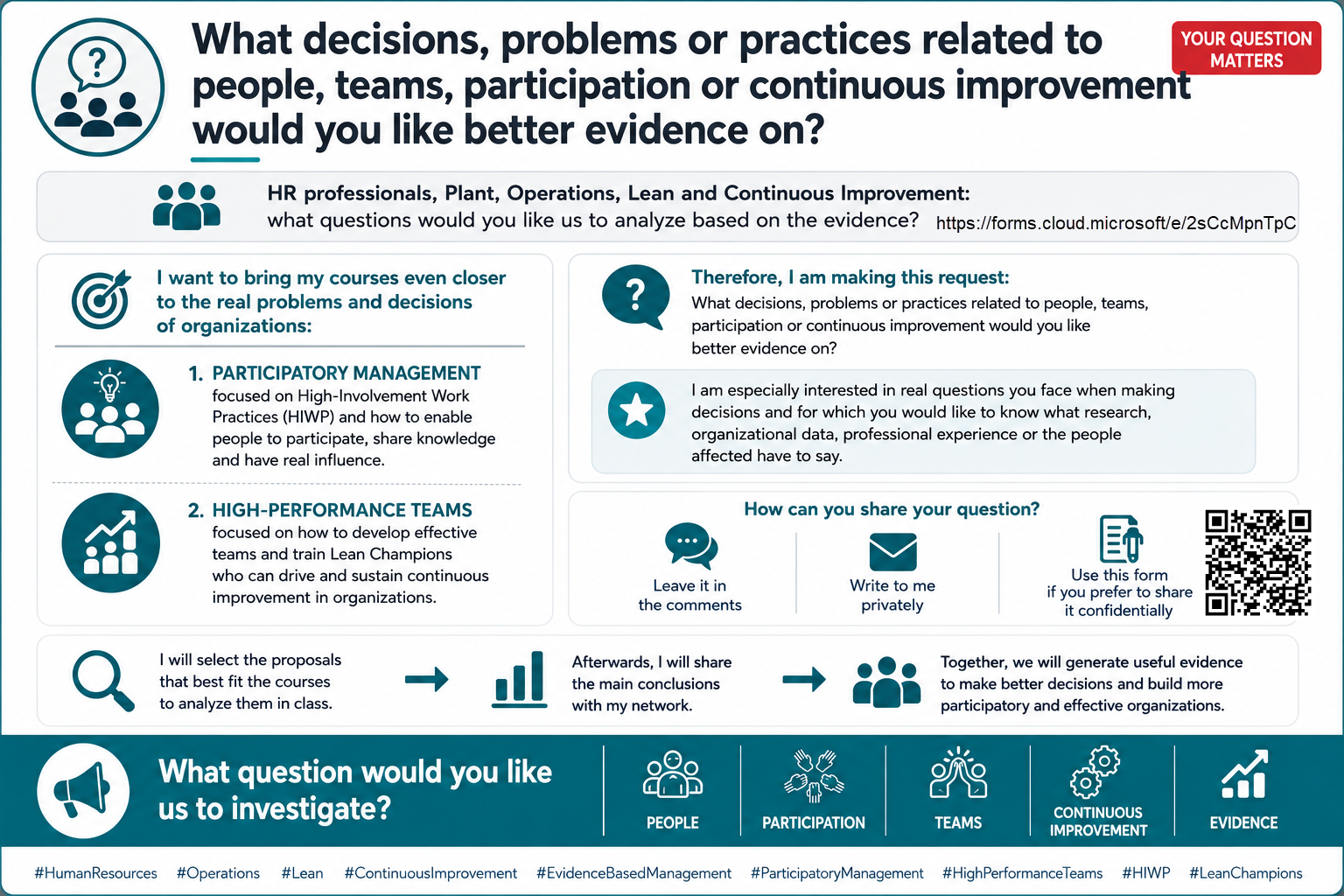
¿Sobre qué decisiones, problemas o prácticas relacionadas con personas, equipos, participación o mejora continua os gustaría disponer de mejor evidencia?

Profesionales de RR. HH., Planta, Operaciones, Lean y Mejora Continua: ¿qué preguntas os gustaría que analizáramos desde la evidencia?

Quiero acercar todavía más mis asignaturas a los problemas y decisiones reales de las organizaciones:

🔹 Gestión Participativa, centrada en las High-Involvement Work Practices (HIWP)y en cómo conseguir que las personas participen, aporten conocimiento y tengan capacidad real de influencia.

🔹 Equipos de Alto Rendimiento, orientada a cómo desarrollar equipos eficaces y formar Lean Champions capaces de impulsar y sostener la mejora continua en las organizaciones

Por eso, os planteo una petición:

¿Sobre qué decisiones, problemas o prácticas relacionadas con personas, equipos, participación o mejora continua os gustaría disponer de mejor evidencia?

Me interesan especialmente preguntas reales que tengáis que responder para tomar decisiones y para las que os gustaría conocer qué dicen la investigación, los datos de las organizaciones, la experiencia profesional o las personas afectadas.

Podéis dejar vuestra pregunta en este formulario: https://forms.cloud.microsoft/e/2sCcMpnTpC

Seleccionaré las propuestas que mejor encajen con las asignaturas para analizarlas en clase y, posteriormente, compartiré las principales conclusiones con mi red.

¿Qué pregunta os gustaría que investigáramos?

#RecursosHumanos #Operaciones #Lean #MejoraContinua #EvidenceBasedManagement #GestiónParticipativa #EquiposDeAltoRendimiento #HIWP #LeanChampions
Visitas: 6

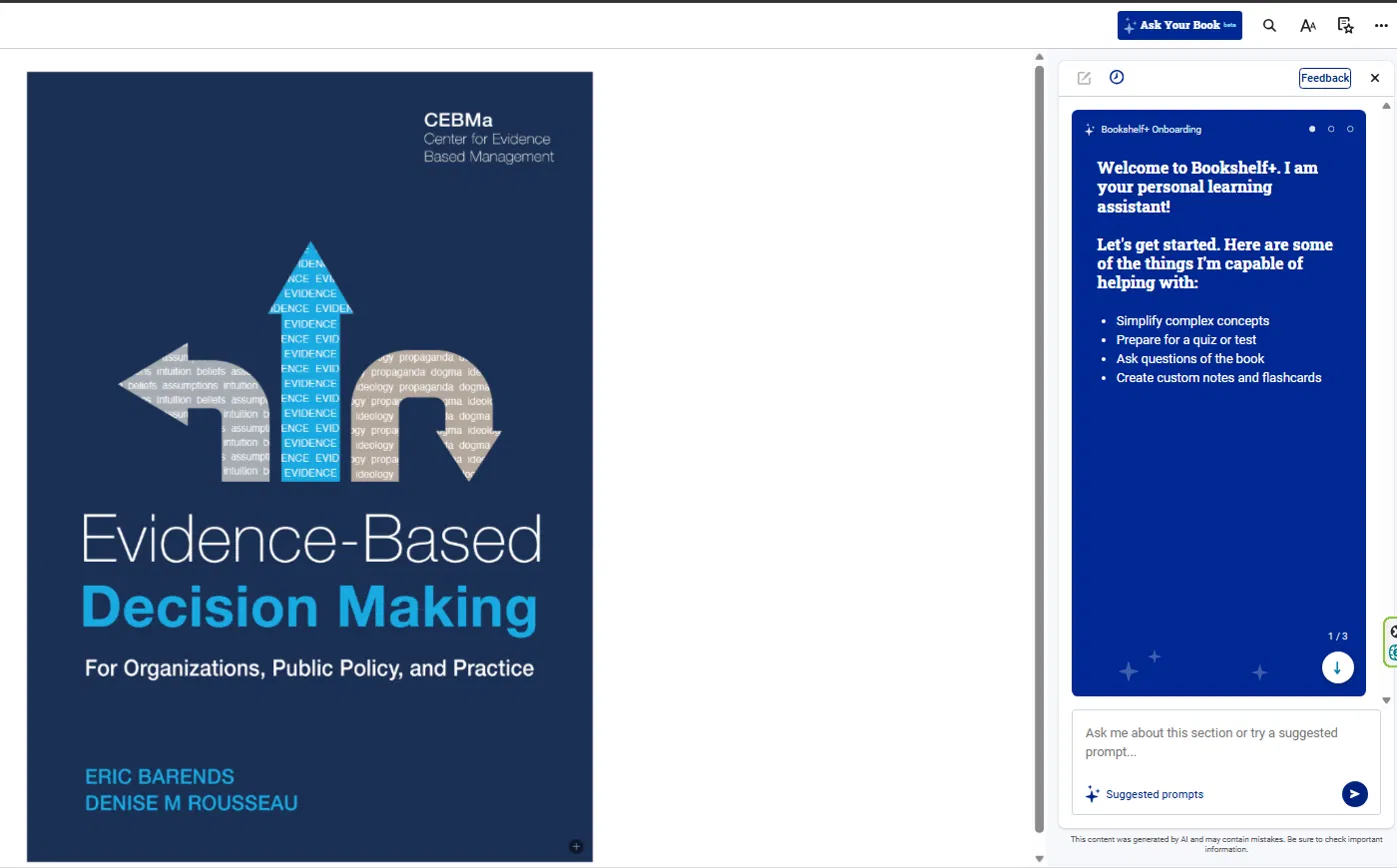
I Don’t Want AI to Summarize a Book Before I’ve Even Started

I use a digital reading platform because the book I need is not available in print. I want to read it. Nothing more, and nothing less.

And yet Bookshelf+ puts an artificial intelligence assistant front and center, offering to simplify concepts, create quizzes and summaries, and answer questions about the book. It is not a discreet tool that I can activate when I need it. It is the first layer of the reading experience. And I definitely do not want that.

I do not mind that other people may find this feature useful. What I object to is having it visually imposed on me, occupying a privileged space and shaping my relationship with the text from the very beginning. If I decide to use AI, I will do so when I believe it can help me.

When I buy a physical book and open it to the first page, a genie does not pop out of a lamp and ask whether I would like a summary. Thankfully. First, I read, think, connect ideas, go back, underline, take notes, and try to understand the text for myself. Only when I get stuck do I look for help. That order matters.

Reading is not merely about extracting information as quickly as possible. It also means pausing, doubting, interpreting, making mistakes, and developing an interpretation of your own. A summary can be useful in certain circumstances, but it should not become the gateway to a book (least of all on a platform whose very purpose is supposed to be facilitating reading).

It is even more baffling that Bookshelf+ has devoted resources to integrating this assistant while still failing to provide even minimally competent annotation and highlighting tools. I cannot find a satisfactory way to work with my notes, export them, or integrate them with Zotero or Obsidian. Those are the kinds of features that would genuinely add value for someone reading for study, research, or work.

A good digital reading tool should help me make the text my own: highlight passages, write comments, organize ideas, preserve references, and transfer that work into my knowledge vault. Instead, the platform’s major investment appears to be an AI that offers to process the book on my behalf.

Bookshelf+ is embarking on a costly and uncertain venture that may ultimately make the book itself less necessary, while neglecting the features that would help people read it better. I need a platform that respects my attention and gives me effective tools for working with the text.

First, I want to read. Then, perhaps, I will ask for help.

Bad, Bookshelf. Very bad.

Visitas: 8

Cien años evaluando el rendimiento, cero filtros a prueba de IA

 El problema del performance management no es evaluar (Pulakos, Mueller Hanson, Arad y Moye, 2015). El sistema no está roto porque midamos, sino porque medimos algo que se ha desconectado de aquello a lo que debía servir. La evaluación se ha vuelto trámite (rellenar una casilla, cerrar el expediente) y ha dejado de asociarse a la conducta real que se pretende mejorar. Los que critican la evaluación del rendimiento no son cuatro recién llegados.

Deming (1986) ya metía la calificación anual por méritos entre sus enfermedades mortales, con el argumento de que atribuimos a la persona lo que en realidad produce el sistema. Da igual que hablemos de notas o de incentivos: el premio contingente parece fomentar la motivación extrínseca y erosiona la motivación intrínseca que es justo la que normalmente interesa potenciar. La métrica que sustituye el juicio profesional por un indicador, en cuanto tiene consecuencias, alguien aprende a maquillarla (Campbell, 1979; Strathern, 1997). Murphy (2020) ya escribió hace unos años: “performance evaluation will not die, but it should”.

Todo esto es anterior a la IA. Lo interesante es releerlo ahora porque la IA no ha traído un problema nuevo; ha añadido una capa encima de los de siempre. A los problemas de toda la vida (el sesgo del que evalúa, el trámite, el indicador que se maquilla) se suma ahora el postureo: que lo que evalúo no lo haya escrito quien lo firma, y que la propia evaluación tampoco la escriba quien la firma. El indicador se externaliza a una máquina. Y el filtro que teníamos, afinado durante décadas, no está preparado para esto.

Nuestra evaluación sumativa en la universidad está rota por lo mismo que el performance management. No porque la evaluación sumativa no sirva (sirve, y no voy a discutirlo), sino porque también se ha desconectado. La nota certifica cada vez menos lo que dice certificar, y la IA solo ha hecho visible una desconexión que ya venía de antes.

La tentación fácil es contestar “pues no evaluamos”, “quitamos el filtro” o “esto es demasiado difícil de evaluar, así que no lo evaluamos”. El reto es construir un marco para hacerlo bien, asumiendo que es complejo y que habrá que rehacerlo cuando cambien las condiciones. La dificultad de evaluar nunca ha sido excusa para dejar de evaluar, ha sido el motivo para diseñar mejor.


Es la misma conclusión de Murphy y DeNisi (2023): deshacerse de la evaluación no es la respuesta. Lo que toca es rediseñar, seguramente desde cero, no solo hacer normativas o recomendaciones (Corbin, Dawson, Nicola-Richmond y Partridge, 2025). Significa replantear la evaluación a nivel de programa y de forma colaborativa, algo que Nicola-Richmond, Dawson, Partridge y Macfarlane (2025) describen como un asunto de comunidad, más que de asignatura suelta. O sea, un trabajo enorme. No sabemos todavía cómo hacerlo bien en tiempo de IA, con el agravante de que ahora ni siquiera nos queda el consuelo del filtro viejo que, aunque fuera imperfecto, nos dejaba dormir tranquilos.


Referencias:

  • Campbell, D. T. (1979). Assessing the impact of planned social change. Evaluation and Program Planning, 2(1), 67–90. https://doi.org/10.1016/0149-7189(79)90048-X
  • Corbin, T., Dawson, P., & Liu, D. (2025). Talk is cheap: Why structural assessment changes are needed for a time of GenAI. Assessment & Evaluation in Higher Education, 50(7), 1087–1097. https://doi.org/10.1080/02602938.2025.2503964
  • Craig, P., Dieppe, P., Macintyre, S., Michie, S., Nazareth, I., & Petticrew, M. (2008). Developing and evaluating complex interventions: The new Medical Research Council guidance. BMJ, 337, a1655. https://doi.org/10.1136/bmj.a1655
  • Deming, W. E. (2000). Out of the Crisis. MIT Press.
  • Murphy, K., & DeNisi, A. (2023). New approaches to dealing with performance management: Getting rid of performance appraisals is not the answer. IIM Ranchi Journal of Management Studies, 2(2), 143–158. https://doi.org/10.1108/IRJMS-09-2023-0074
  • Murphy, K. R. (2020). Performance evaluation will not die, but it should. Human Resource Management Journal, 30(1), 13–31. (WOS:000490177200001). https://doi.org/10.1111/1748-8583.12259
  • Nicola-Richmond, K., Dawson, P., Helen, P., & Macfarlane, S. (2025). It takes a village… Program-wide approaches to redesigning assessment in a time of generative artificial intelligence (GenAI). Journal of University Teaching and Learning Practice, 22(7), e1711–e1711. https://doi.org/10.53761/zpp2ja61
  • Pulakos, E. D., Hanson, R. M., Arad, S., & Moye, N. (2015). Performance Management Can Be Fixed: An On-the-Job Experiential Learning Approach for Complex Behavior Change. Industrial and Organizational Psychology, 8(1), 51–76. https://doi.org/10.1017/iop.2014.2
  • Skivington, K., Matthews, L., Simpson, S. A., Craig, P., Baird, J., Blazeby, J. M., Boyd, K. A., Craig, N., French, D. P., McIntosh, E., Petticrew, M., Rycroft-Malone, J., White, M., & Moore, L. (2021). A new framework for developing and evaluating complex interventions: Update of Medical Research Council guidance. BMJ, 374, n2061. https://doi.org/10.1136/bmj.n2061
  • Strathern, M. (1997). ‘Improving ratings’: Audit in the British University system. European Review, 5(3), 305–321. https://doi.org/10.1002/(SICI)1234-981X(199707)5:3%253C305::AID-EURO184%253E3.0.CO;2-4

Visitas: 9