
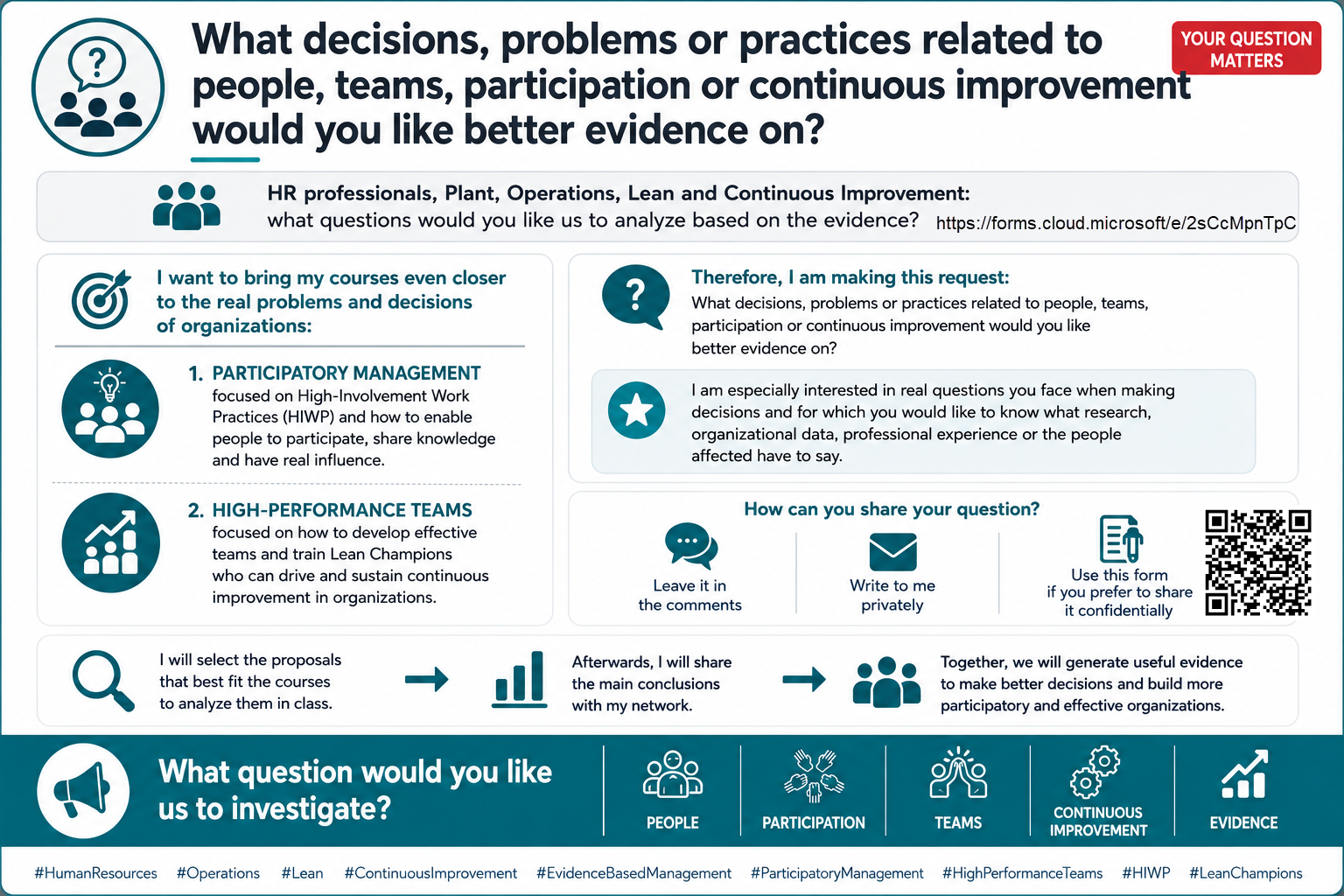
¿Sobre qué decisiones, problemas o prácticas relacionadas con personas, equipos, participación o mejora continua os gustaría disponer de mejor evidencia?

Profesionales de RR. HH., Planta, Operaciones, Lean y Mejora Continua: ¿qué preguntas os gustaría que analizáramos desde la evidencia?

Quiero acercar todavía más mis asignaturas a los problemas y decisiones reales de las organizaciones:

🔹 Gestión Participativa, centrada en las High-Involvement Work Practices (HIWP)y en cómo conseguir que las personas participen, aporten conocimiento y tengan capacidad real de influencia.

🔹 Equipos de Alto Rendimiento, orientada a cómo desarrollar equipos eficaces y formar Lean Champions capaces de impulsar y sostener la mejora continua en las organizaciones

Por eso, os planteo una petición:

¿Sobre qué decisiones, problemas o prácticas relacionadas con personas, equipos, participación o mejora continua os gustaría disponer de mejor evidencia?

Me interesan especialmente preguntas reales que tengáis que responder para tomar decisiones y para las que os gustaría conocer qué dicen la investigación, los datos de las organizaciones, la experiencia profesional o las personas afectadas.

Podéis dejar vuestra pregunta en este formulario: https://forms.cloud.microsoft/e/2sCcMpnTpC

Seleccionaré las propuestas que mejor encajen con las asignaturas para analizarlas en clase y, posteriormente, compartiré las principales conclusiones con mi red.

¿Qué pregunta os gustaría que investigáramos?

#RecursosHumanos #Operaciones #Lean #MejoraContinua #EvidenceBasedManagement #GestiónParticipativa #EquiposDeAltoRendimiento #HIWP #LeanChampions
Visitas: 0

I Don’t Want AI to Summarize a Book Before I’ve Even Started

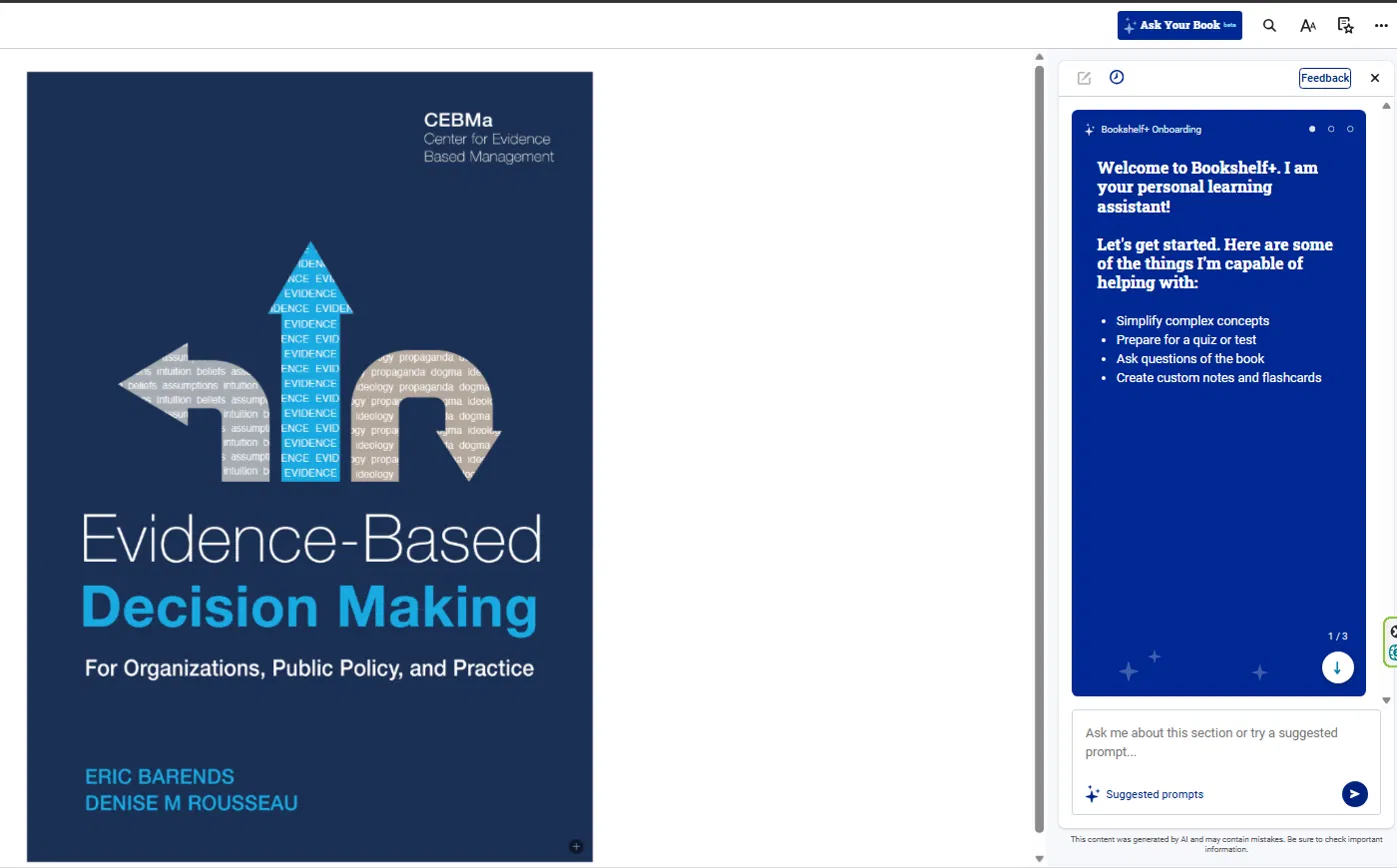
I use a digital reading platform because the book I need is not available in print. I want to read it. Nothing more, and nothing less.

And yet Bookshelf+ puts an artificial intelligence assistant front and center, offering to simplify concepts, create quizzes and summaries, and answer questions about the book. It is not a discreet tool that I can activate when I need it. It is the first layer of the reading experience. And I definitely do not want that.

I do not mind that other people may find this feature useful. What I object to is having it visually imposed on me, occupying a privileged space and shaping my relationship with the text from the very beginning. If I decide to use AI, I will do so when I believe it can help me.

When I buy a physical book and open it to the first page, a genie does not pop out of a lamp and ask whether I would like a summary. Thankfully. First, I read, think, connect ideas, go back, underline, take notes, and try to understand the text for myself. Only when I get stuck do I look for help. That order matters.

Reading is not merely about extracting information as quickly as possible. It also means pausing, doubting, interpreting, making mistakes, and developing an interpretation of your own. A summary can be useful in certain circumstances, but it should not become the gateway to a book (least of all on a platform whose very purpose is supposed to be facilitating reading).

It is even more baffling that Bookshelf+ has devoted resources to integrating this assistant while still failing to provide even minimally competent annotation and highlighting tools. I cannot find a satisfactory way to work with my notes, export them, or integrate them with Zotero or Obsidian. Those are the kinds of features that would genuinely add value for someone reading for study, research, or work.

A good digital reading tool should help me make the text my own: highlight passages, write comments, organize ideas, preserve references, and transfer that work into my knowledge vault. Instead, the platform’s major investment appears to be an AI that offers to process the book on my behalf.

Bookshelf+ is embarking on a costly and uncertain venture that may ultimately make the book itself less necessary, while neglecting the features that would help people read it better. I need a platform that respects my attention and gives me effective tools for working with the text.

First, I want to read. Then, perhaps, I will ask for help.

Bad, Bookshelf. Very bad.

Visitas: 2