
Using AI to Make Literature Reviews Smarter and More Efficient

Marin-Garcia, J. A., Martinez-Tomas, J., Juarez-Tarraga, A., & Santandreu-Mascarell, C. (2024). Protocol paper: From Chaos to Order. Augmenting Manual Article Screening with Sentence Transformers in Management Systematic Reviews. WPOM-Working Papers on Operations Management15, 172–208. https://doi.org/10.4995/wpom.22282

What is it about?

This protocol paper describes a new method to help researchers screen and classify scientific articles more efficiently during systematic literature reviews. The authors propose using AI language models called “sentence transformers” to automatically analyze article titles and abstracts, comparing them to the review’s topic of interest. This helps researchers prioritize which articles to review first, rather than working through them randomly. The method was tested with 14 different AI models on a small set of articles about workplace management practices.

Featured Image

Why is it important?

As scientific publications grow exponentially, researchers struggle to efficiently review all relevant literature. This method could: * Save significant time in the screening process * Reduce researcher fatigue and potential bias * Make systematic reviews more accessible to researchers with limited resources * Help democratize access to advanced AI tools for academic research * Support evidence-based management practices by making literature reviews more feasible The approach is particularly valuable because it’s designed to complement rather than replace human judgment, and can be implemented using free, accessible tools.

Perspectives

This protocol represents an innovative bridge between cutting-edge AI technology and traditional academic research methods. The authors’ commitment to making the tool freely available and easy to use for researchers worldwide, regardless of technical expertise or resources, is particularly noteworthy. The pilot results suggest promising potential, though more testing is needed to validate the approach at larger scales.

Professor Juan A. Marin-Garcia
Universitat Politecnica de Valencia

Read the Original

This page is a summary of: Protocol paper: From Chaos to Order. Augmenting Manual Article Screening with Sentence Transformers in Management Systematic Reviews, WPOM – Working Papers on Operations Management, December 2024, Universitat Politecnica de Valencia,
DOI: 10.4995/wpom.22282.

Visitas: 10

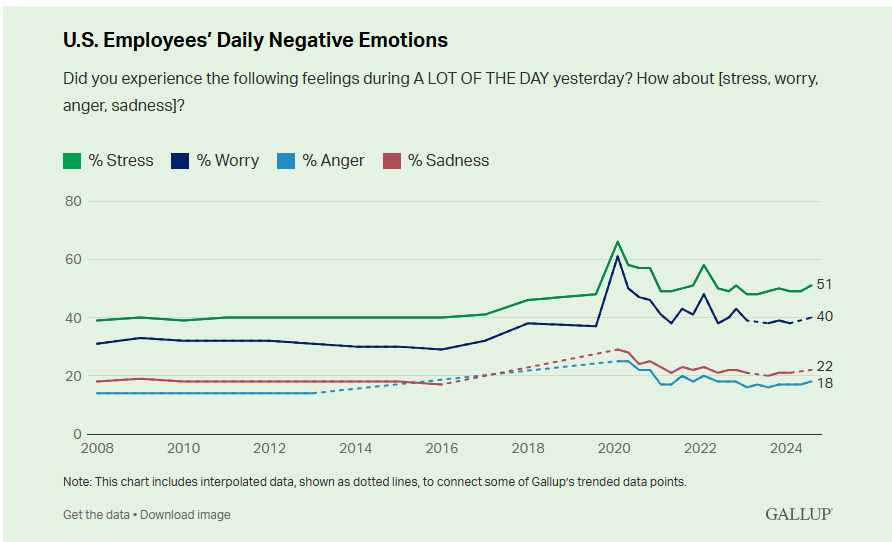
La implicación y las emociones negativas en USA ¿Spain is different?

En una encuesta reciente de GALLUP, se preguntaba si los participantes experimentaron emociones como estrés, preocupación, enojo o tristeza durante gran parte del día anterior.

  1. El estrés es la emoción negativa más reportada y ha mostrado una tendencia ascendente desde 2008. Aumentó en 2020 (posiblemente debido a la pandemia de COVID-19) y aunque se ha reducido, se mantiene en niveles superiores a pre-pandemia
  2. La preocupación se mantuvo relativamente constante hasta 2020, cuando también aumentó bruscamente. Posteriormente, comenzó a disminuir ligeramente, estabilizándose alrededor del 40% en 2024 (valor superior a pre-pandemia).

  3. La tristeza tuvo un aumento gradual hasta 2020 y luego disminuyó ligeramente. Actualmente se encuentra en 22%.

  4. El enojo es la emoción menos frecuente entre las cuatro, con valores cercanos al 18% en 2024. Ha mostrado una tendencia relativamente estable con leves fluctuaciones.

Conclusión:

La gráfica destaca cómo las emociones negativas (particularmente el estrés y la preocupación) aumentaron durante períodos críticos como la pandemia, aunque algunas han disminuido desde entonces. Sin embargo, el estrés sigue siendo un factor presente en la vida diaria de los empleados en Estados Unidos.

¿Qué valores tendremos para estos indicadores en España? ¿Será una tendencia parecida? Pero, sobre todo, ¿seremos capaces de identificar las causas y no solo de describir un fenómeno?

Visitas: 14

Publicado-Marin-Garcia & EtAl (2016) Proposal of a Framework for Innovation Competencies Development and Assessment (FINCODA)

Marin-Garcia, J., Andreu Andres, M., Atares-Huerta, L., Aznar-Mas, L., Garcia-Carbonell, A., González-Ladrón-de-Gevara, F., Montero Fleta, B., Perez-Peñalver, M., & Watts, F. (2016). Proposal of a Framework for Innovation Competencies Development and Assessment (FINCODA). WPOM-Working Papers on Operations Management, 7(2), 119-126. doi:http://dx.doi.org/10.4995/wpom.v7i2.6472

In this article we propose an innovation competence model of the people which is based on the existing literature to integrate and complement existing models. The main contribution of this work consists in demonstrating the differences and similarities of current models and in providing a conceptual definition for each model element. In this way, both researchers and people in charge of human resources in companies obtain a framework with which to design measuring instruments to assess innovation competence, which can fulfill the twofold demand of validity and reliability.

This work has been conducted as part of a European project financed by the European Union [“FINCODA” Project 554493-EPP-1-2014-1-FI-EPPKA2-KA] (http://bit.ly/FINCODA-EUsite01). (The European Commission support for the production of this publication does not constitute an endorsement of the contents which reflects the views only of the authors, and the Commission cannot be held responsible for any use which may be made of the information contained therein); and by the Universitat Politénica de Valencia PIME/2015/A/009/A “Evaluation of innovative behavior indicators in university students”.

Cartton abstract

Keywords

competence assessment; innovation; model; literature review

Visitas: 35